

ARTHUR PHILLIP CHAPTER OF THE FELLOWSHIP OF THE FIRST FLEETERS
  • Welcome
    • About Arthur Phillip Chapter
    • Chapter Membership
    • Contact Us
    • Roll of members' First Fleeters
    • My Heritage, Colonial Family Stories >
      • Heroes of the Great Gundagai Flood and story of Richard Hunt
      • Bartholomew Reardon Part 1
      • Coulter-Reardon family story Part 2
      • Cook, Captain James 250th anniversary 2020 >
        • Planning for the voyage
        • The voyage begins
        • First sighting of the east coast of Australia
        • At Botany Bay
        • The Voyage North along the East Coast
        • Excerpts from Cook's journal
        • New memorial at Cook's landing site
      • Cook, Captain James RN, His Life Story
      • Fulton, Rev Henry James
      • Goodwin-Munro-Frost story
      • Bellett, Jacob, First Fleeter
      • Hibbs, Peter & Pardoe, Mary
      • Weavers, James, 2nd Fleeter
      • Weavers, James Part 2
      • Wentworth, William Charles
      • Williams, James, FF Welsh Marine
      • Wright, James, FF Scarborough
    • Snippets of History >
      • Snippet in Brief
      • Our Flag - a poem
      • Australia's Secret Code-Breakers
      • Sydney Observatory
      • Sydney's first post offices
      • Charge of Australian Light Horse at Beersheva WW1
      • Battle of Waterloo
      • South Head's history
      • Westminster Abbey Memorials & Citation
      • Wallabadah First Fleet Park, NSW
  • Meetings
    • About our Meetings & Activities
    • Calendar of Events
    • Location, how to get there
    • Recent Events & Activities >
      • Report on State Library tour 3.5.19
      • Report on Matthew Flinders presentation by Paul Brunton
      • Report on Tasmanian Convict Heritage Tour 2018
      • Report on Pioneer Park official opening
  • Fellowship of First Fleeters
    • About Fellowship of First Fleeters
    • About the First Fleet
    • HMS Sirius Flag Ship of the First Fleet
    • Dr John White, First Fleet Surgeon
    • Health of the First Fleet
    • Weather Secrets
    • Map of the First Fleet Voyage
    • How to write FFF biographical profiles
  • Governor Arthur Phillip
    • Captain Arthur Phillip's background
    • Phillip's Early Years
    • Arthur Phillip: Speech by Dr Stephen Cunneen
    • Exploration of Middle Harbour Creek
    • Exploration of Manly & Harbour
    • Governor Phillip Lookout & Memorial at Beacon Hill
    • Exploration of Lane Cove River
    • The Phillip Bricks
  • Research & Study
    • Research Guidelines
    • Websites & Facebook for Family History Research
    • Government Websites for Social History Research >
      • Australian Constitution
    • Websites for Historical & Family Heritage Societies
    • Overseas Websites for Family History Research
    • Free Build Your Own FamilyTree Websites
    • Chapter Library & Catalogue
    • MORE >
      • Chapter Policies
      • Acknowledgements
Picture
Picture
Picture

The Battle of Waterloo and its impact on the Colony
 
The year 2015 was the 200th anniversary of the Battle of Waterloo, fought on Sunday, 18 June 1815, near Waterloo about 15 kilometres south of Brussels, then part of the United Kingdom of the Netherlands. The French, under the command of Napoleon Bonaparte, was defeated by the armies of the Seventh Coalition, comprising an Anglo-allied army under the command of Great Britain's Duke of Wellington, thus ending years of conflict.

On 17 January 1816, the Sydney Gazette announced the news of Bonaparte's defeat, carried by  a newly arrived ship (a reminder of the isolation of the colony and the time it took for ships to sail from Europe).  The colonists were jubilant and the same night a gay assemblage gathered in room at the recently completed Sydney Hospital at Macquarie Street for a ball and supper. The building large enough to be used for purposes other than the care of patients.  The room decorated with patriotic insignia, stars, and the royal arms, with the mottoes Waterloo, Wellington and Victory emblazoned on the floor.  Native shrubs, evergreens and flowers hung in graceful festoons.  The dancing, drinking, and merriment continued till dawn.  At a church service that followed, the community sang psalms of praise and thanksgiving for the British victory and demonstrated their fervent gratitude to the disabled soldiers by subscribing to a fund for the relief of the Sufferers of the Battle of Waterloo. The inner suburb of Sydney was subsequently named for this momentous battle.

Images from the internet.
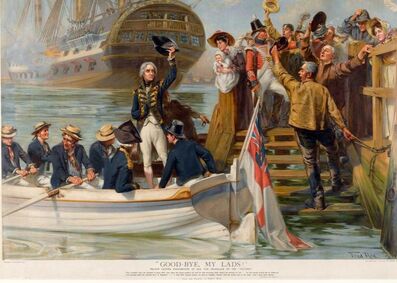
Top left:  Nelson waving goodbye to an admiring crowd at Portsmouth, England.
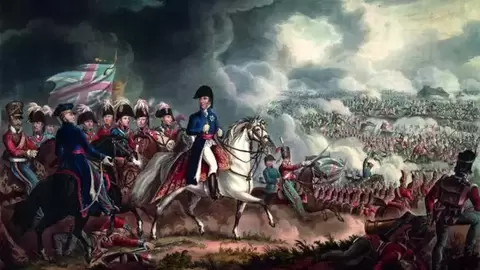
Top right:  Leading the British charge at Waterloo.
​Above:  The Duke of Wellington directing maneuvers at the battle site.
​
© Arthur Phillip Chapter of Fellowship of First Fleeters 2023 -

Powered by Create your own unique website with customizable templates.